


The Finch Family of the Rookery from c.1609 to 1854
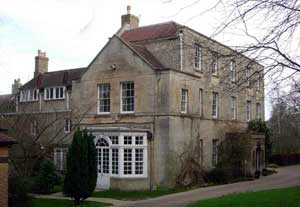
The Finch family built The Rookery in Old Headington (now Ruskin College) and lived there from about 1660 to 1854. It was finally sold by the Finch Trustees in 1873.
They were big Headington landowners, and the Rookery land once included most of the east side of Stoke Place, Barton West, and the whole of the Highfield Farm estate on the south side of the London Road.
Finch Close in Headington is named after them.

Bartholomew Finch senior (c.1609–1668)
and his wife Elizabeth
Bartholomew Finch senior was a cook at New College, Oxford and “Master of the Society of the Cooks of the University of Oxon”. He was the father of William Finch who built the Rookery in c.1660.
In 1647 he was living at 46 Broad Street, Oxford (right), which was on the site of the Weston Library. He was probably still living in this house in 1665, when he paid tax on eight hearths in the parish of St Mary Magdalen. His brother William Finch (died 1694) was also a New College cook.
Bartholomew Finch senior and his wife Elizabeth at least three sons:
- William Finch
- Bartholomew Finch junior
- Abraham Finch (probably)
- Francis Finch (born c.1638)
It appears that Bartholomew Finch senior may have also run an eating or drinking establishment at 46 Broad Street, as Anthony Wood records paying a number of visits to “Bat Finch’s” premises with his friends. Wood was also a friend of the Finch family: when he wrote on 3 August 1666 about the baptism at Merton College Chapel of Anne Wood, daughter of his brother Robert, he said that one of her three sponsors was Edith Finch, the wife of Bartholomew Finch, cook, of St Mary Magdalen parish. It seems unlikely that he would have made mistake with the name of Finch’s wife Elizabeth, so he may be referring to Bartholomew Finch junior, who because of his age would have been a more suitable sponsor. (To further confuse matters, a Bartholomew Finch married Mary Knowles at St Peter-le-Bailey Church in Oxford on 2 January 1644.)
On 2 May 1659, a man called Bartholomew Finch, probably his son, was married at Holywell Church, but the name of his bride is not given.
In 1665 Bartholomew Finch paid window tax on eight windows at 46 Broad Street, and in 1667 at that address he paid poll tax on wages £1 and money £100 as follows: £1-2-0 for himself and a shilling for both his wife Elizabeth and for Abraham Finch (presumably his son), plus payments for four other people who presumably worked for him. A man called Bartholomew Finch also paid a shilling poll tax in 1867 in Holywell parish.
Bartholomew Finch senior died at the age of 59 on 2 July 1668 and was buried in New College cloisters where his nephew Matthew Finch, who had died three years earlier at the age of 27, was already buried. Anthony Wood wrote as follows about their graves:
In the north cloister are certaine white stones laid over the graves of servant buried there, viz. … for Barthelmew Finch, Master of the Society of Cookes in Oxon, and cook of this college, who died 2 July 1668, aet. 59. His epitaph is in Latine and put at the charges of Elizabeth his wife. It layes at the feet of Mathew Finch, his nephew, whose epitaph is printed in “Hist. et Antiq. Univ. Oxon”.
His will of 1 June 1668 was proved in the Chancellor’s Court of the University of Oxford. The house in Broad Street passed first to his wife Elizabeth Finch.
His son Bartholomew Finch junior was buried at St Cross (Holywell) Church on 20 June 1675, just seven years after his father.
By 1689 another Bartholomew Finch had a lease from Trinity College of Kettell Hall in St Mary Magdalen parish.
Following the death of Bartholomew Finch senior's wife, Kettell Hall passed to his youngest son Francis Finch, who had been apprenticed to the barber William Flexney on 1 August 1656, and became the New College barber. He died on 5 November 1680 at the age of 41, according to Wood as he continued to describe the white stones laid over servants’ graves in the north cloister of New College:
Neare the monument of Barthelmew Finch, is a larg marble of a diamond square containing this:—
“Francis Finch, late barber of this college, died 5 Novemb. an. 1680, aged 41.“
William Finch (d.1697), cook at New College and builder of the Rookery
Eldest son of Bartholomew Finch junior
William Finch, the eldest son of Bartholomew Finch junior, was a cook of New College like his grandfather. In about 1660 he converted a sixteenth-century dwelling at the north-west end of Headington village that was previously in peasant occupation into what became commonly known as The Rookery. Part of this conversion still remains as the centre of the present house.
There is a 1674 terrier (ref. 567/99/1, held by Plymouth Archives) relating to lands belonging to William Finch of Headington among the documents of the Plymouth solicitors Shelly & Johns.
In 1677 William’s father’s old house at 46 Broad Street was jointly owned by his brother Francis Finch and by Abraham Finch: they let it out to a cook called Richard Hedges. Francis died on 5 November 1680.
William Finch died in 1697 without a male heir and was buried at St Andrew’s Church in Headington on 6 March that year. The Rookery appears to have passed to his nephew Abraham Finch, the eldest son of his brother, another Bartholomew Finch
Abraham Finch (d.1703), head cook at New College, Oxford
and his wife
Elizabeth (d.1711)
Nephew of William Finch, cook of New College
Abraham Finch, head cook at New College, and his wife Elizabeth had the following children:
- William Finch (baptised at Holywell Church on 1 November 1672, recorded as son of Abraham)
- Bartholomew Finch (baptised at Holywell Church on 10 January 1674/5, recorded as son of Abraham);
died in infancy and buried in the chancel of St Mary Magdalen Church on 15 September 1677 - Abraham Finch (baptised at St Mary Magdalen Church on 3 June 1677);
died in infancy and buried in the chancel of that church on 28 September 1679 - Francis Finch (baptised at St Mary Magdalen Church on 16 December 1679)
- Elizabeth Finch (baptised at St Mary Magdalen Church on 28 April 1682);
died in infancy and buried at that church on 26 July 1682 - Matthew Finch (baptised at St Mary Magdalen Church: on 22 March 1682/3);
died in infancy and buried at that church on 6 April 1683.
It appears the family lived in Holywell between at least 1672 to 1674, and then moved to the parish of St Mary Magdalen, probably to Broad Street; but they do not appear to have lived at 46 Broad Street, because although Abraham Finch was the sole owner of this house by 1691, he then let it out to Elizabeth Hedges; and by 1705 she appears to have been the owner.
On 1 July 1688 Francis Finch, aged 16, the son of Abraham Finch, a gentleman of Oxford, was matriculated at the University of Oxford by New College. He became a Fellow of Trinity College, obtaining his M.A. in 1705 and his B.D. in 1714. He died in 1731.
In 1696 Abraham Finch paid tax on a house with twenty windows in St Mary Magdalen parish: this is likely to be Kettell Hall in Broad Street, which was leased to various members of the Finch family.
Abraham Finch inherited the Rookery in 1697 but only had it for four years as he died near the end of 1701. He was buried at St Mary Magdalen Church on 3 December, described in the register as “Cook worth £600”. His widow Elizabeth Finch was also buried there on 27 September 1711.
William Finch, Gentleman of Headington (1672–1752)
and his wife Mary Lewington of Stanton St John (c.1674–1743)
Eldest son of Abraham and Elizabeth Finch
On 26 November 1696 William Finch married Mary Lewendon or Lewington of Stanton St John at St Cross (Holywell) Church (whose parish included New College). They had two sons:
- Richard Finch (baptised at St Andrew’s Church, Headington on 8 April 1700;
died at the age of ten and buried at St Mary Magdalen Church on 7 July 1710) - Thomas Finch (baptised at St Andrew’s Church, Headington on 8 November 1705).
In 1714 he was on the point of selling Kettell Hall in Broad Street to Balliol College, but Trinity College managed to seal articles with Finch on 15 April for this house.
Subsequently the Finch family appears to have been based entirely in Headington. On 17 September 1714 city council records show that William Finch of Headington was awarded a Chamberlain’s place, gratis.
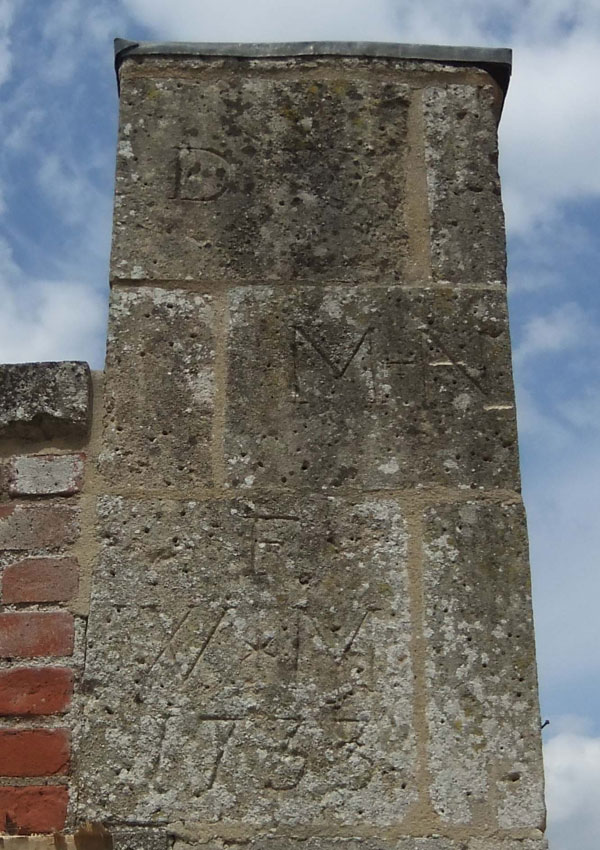
It may have been William Finch who created the walled garden at the Rookery.
Three inscribed stones (left) are now at the south entrance of the walled garden at the Rookery, but it is thought that they were moved there from elsewhere on the site.
Top stone on left:
D+W
Middle stone on right:
M+N
Bottom stone on left:
F
W x M
1733
This obviously commemorates something that happened in 1733, but its exact meaning is unclear. It seems likely that “F W x M” stands for “Finch, William and Mary”
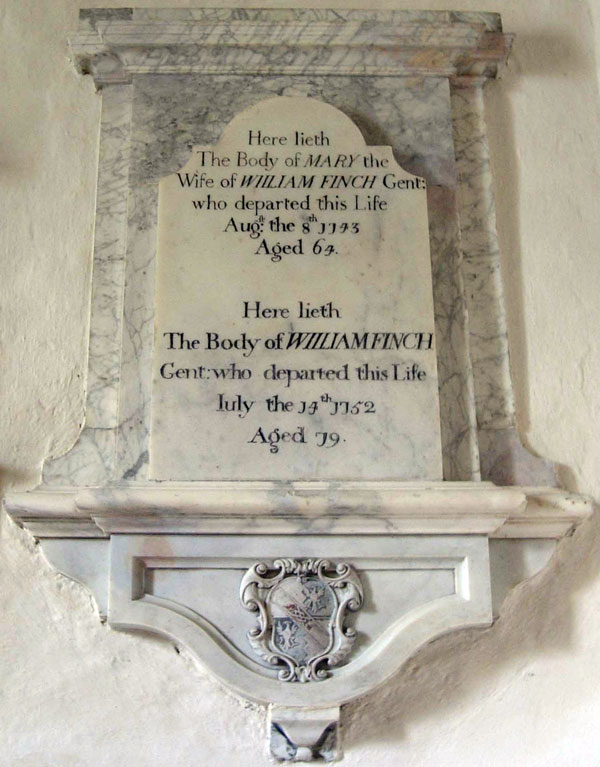
Mrs Mary Finch died on 8 August 1743 at the age of 64, and was buried in the chancel of St Andrew’s Church three days later.
William Finch died on 14 July 1752 at the age of 79, and was buried with his wife two days later.
There is a memorial to the couple (right) on the chancel wall. It reads:
Here lieth
The Body of MARY the
Wife of WILLIAM FINCH Gent:
who departed this Life
Augt. the 8th 1743
Aged 64.
Here lieth
The Body of WILLIAM FINCH
Gent: who departed this Life
Iuly the 14th 1752
Aged 79.
The arms beneath with two spread eagles do not appear to be those of either the Finch or Lewington families.
Early Finch Wills proved in the Court of the Chancellor of the University of Oxford
- 1668, 1 June: Bartholomew Finch, cook, brother of William and father of Abraham below
Will with no note of Record of Probate or administration.
Will proved at the Prerogative Court at Canterbury - 1680, 20 November: Francis Finch, barber, son of Bartholomew above and nephew of William following
Record of a grant of Probate with no Will extant - 1694, 18 May: William Finch, heretofore cook of New College, brother of Bartholomew above
Record of a grant of Probate with no Will extant
Query: FHS transcript states that William Finch was buried at St Andrew's Church on 6 March 1697. - 1702, 10 November: Abraham Finch, cook of New College, son of Bartholomew, and nephew of William above
Record of a grant of Probate with no Will extant
Thomas Finch of Headington (1705–1751), Rector of Holton & Woodeaton,
and his wife Anne (d.1782)
Thomas Finch was the only surviving son of William & Mary Finch
Thomas Finch died one year before his father so presumably never owned the Rookery. He did however grow there with his parents, and it seems likely that he also lived much of the time there after his marriage.
He was matriculated at the age of 16 at the University of Oxford (Trinity College) on 23 February 1721/2 and gained his MA in 1728. On 2 February 1727/8 Thomas Hearne mentioned Thomas and his parents: “Mr Finch of Heddington [his father William] hath a son, a young man, of Trinity College, by his Wife, a fine jolly handsome Woman, the Daughter of Mr. Lewington of Stanton St John’s”.
Thomas Finch was Rector of Holton & Woodeaton from 1735 (succeeding Edmund Whorwood) until his death in 1751. He and his wife Anne had five children:
- Mary Finch (born on 8 May 1737 and baptised at Holton on 2 June 1737). Married Charles Ryder of London at St Andrew’s Church, Headington on 22 January 1761
- Ann Finch (born on 16 June 1838 and baptised at Holton on 30 July 1738. Died aged 11 and buried at St Andrew’s Church, Headington on 31 August 1749
- Richard Finch (born on 4 July 1740 and baptised at Holton on 31 July 1740)
- Elizabeth Finch (born on 8 November 1741 and baptised at Holton on 28 December 1741)
- Jane Finch (baptised at Holton on 3 May 1745). This may be the Jenny Finch, daughter of the then widowed Mrs Finch of Headington, whose death was announced in Jackson’s Oxford Journal as having taken place on 2 December 1771
- William Finch (born on 29 July 1748 and baptised at Holton on 1 March 1749. Died aged four, buried at St Andrew’s Church Headington on 16 July 1752.
Being a pluralist (Rector of both Wood Eaton and Holton), it is likely that the Revd Thomas Finch relied heavily on curates. Hence it appears that spent much of his time after his marriage in Headington, where his daughter Ann was buried in 1749. He died at the age of 45, and was also buried at St Andrew’s Church on 6 August 1751 (his will is in the National Archives).
His wife Anne must have remained at the Rookery, as their youngest son was buried in Headington in 1753, and their daughter Mary was married there in 1761. Anne died at the age of 70 and was buried with her husband on 22 June 1782: in the announcement of her death in Jackson’s Oxford Journal she was described as the mother of an Oxford wine merchant, namely the Richard Finch following.
Richard Finch the Elder of Headington (1740–1802), Gentleman & Wine Merchant,
and his wife Laetitia White of Newington (c.1750–1846)
Richard Finch the elder was the eldest son of Thomas & Anne Finch
Richard was only eleven when his father died in 1751 and twelve when his grandfather died in 1752, so presumably his mother Anne acted as his guardian until he could inherit the Rookery when he reached the age of 21 on 4 July 1761.
When he subscribed to the Radcliffe Infirmary in 1770 he was already described as a wine merchant. City council records show that on 3 June 1771 Mr James Etty and Mr Finch were granted new leases of a vault or cellar under the Town Hall for 40 years for a fine of £3. This lease was renewed in 1785. He also had vaults in the High Street, but these were advertised to let on 24 February 1781.
Richard Finch was a friend of Parson Woodforde, who wrote in his diary on 14 July 1775, “We put about the wine pretty brisk it being Finch’s Birth Day to day, who is now 35 Years old”.
Richard is listed in Jackson’s Oxford Journal between 1786 and 1790 among those renewing their game licences, and he was described as being of Headington (rather than of Oxford, where he had his business) when in October 1775 a horse of his was stolen or strayed from Stow Wood.
It appears that Richard Finch made a failed attempt to sell the Rookery, as Jackson’s Oxford Journal advertised a sale of an improvable estate in Headington, copyhold of inheritance and occupied by Finch, to be held by Way & Son at the Bear in Oxford on 12 June 1777 (with enquiries to Walker of Headington).
On 8 September 1778 when he was 38, Richard Finch of Headington settled down and married Laetitia White at Newington, the witnesses being Harriet Raikes and George White, and their marriage was announced in Jackson’s Oxford Journal. Their five children were born at the Rookery between 1779 and 1794:
- Richard Finch (baptised at St Andrew’s Church on 27 December 1779)
- Laetitia Finch (baptised at St Andrew’s Church on 11 January 1781)
- George Finch (no baptism recorded); died in infancy and buried at St Andrew’s Church on 15 May 1785
- Harriett Finch (baptised at St Andrew’s Church on 19 April 1787);
married William Perry at St Andrew’s Church on 26 January 1809 - Ann Elizabeth Finch (baptised at St Andrew’s Church on 31 October 1790)
- George William Finch (baptised at St Andrew’s Church on 20 July 1794): articled to Robert Hughes of Cheltenham, and Attorney of HM Courts of King's Bench and Common Pleas at Westminster on 22 May 1809
Richard Finch died at the age of 61 and was buried in St Andrew’s churchyard on 28 December 1802. His death was recorded thus in Jackson’s Oxford Journal of 25 December 1802: "On Wednesday last died, in the 62d year of his age, Richard Finch, of Headington, in this county, Esq."
Richard Finch the Younger of Headington (1779–1851)
and his wife Clara Bunce of Marcham (1779–1849)
Richard Finch the Younger was the eldest son of Richard & Laetitia Finch
Richard Finch the younger, the eldest son of Richard and Laetitia Finch, was matriculated at the University of Oxford (Trinity College) at the age of 18 on 15 January 1798, and gained his BA in 1802. His father died at the end of 1802, and so he inherited the Rookery when he was only 23.
He was a member of the Headington Association for Protection against Thieves in April 1803, and was described as being “of Headington” when on 8 October that year he married Clara Bunce of Marcham, Berkshire, at Marcham. The following announcement of the marriage appeared in Jackson’s Oxford Journal of 15 October 1803: “Saturday last was married Richard Finch, Esq. of Headington, near this city, to Miss Bunce, of Sutton Courtney, in the county of Berks.” Clara, the daughter of William and Mary Bunce, was baptised at Marcham on 5 May 1779. They do not appear to have had any children.
Under the Headington Enclosure Award of 1804 (for which his widowed mother Mrs Laetitia Finch was one of the commissioners), Richard Finch the Younger was awarded over 30 acres in lieu of copyhold lands under Heddington Manor, while his mother was awarded 110 acres of land as a lessee of Magdalen College. These 140 acres included the site of the present house called Stoke on the other side of Stoke Place, and Highfield Farm on the other side of the London Road. These lands associated with the Rookery stretched from north of the present northern bypass to as far south as Old Road.
Richard Finch the Younger partially rebuilt the Rookery in about 1810, probably around the time he was married. He lived there with his wife, and his widowed mother Laetitia and his unmarried sister of the same name. He appears to have lived the life of a country gentleman, with Jackson’s Oxford Journal shows him being awarded game certificates in 1801 and 1806, advertising on 11 April 1812 a £1 reward for the loss of a young pointer bitch, and announcing on 7 February 1824 that his ducks had been stolen, and offering for sale on 5 May 1832 a yearling shorthorn bull. In Pigot’s Directory of 1830 he is described as a gentleman of Headington.
By 1840 when he was 61, Richard Finch appears to have tired of managing his estate, and the following advertisement appeared in Jackson’s Oxford Journal on 11 & 18 July:
To be LET, at Michaelmas next, — A pleasant COTTAGE RESIDENCE, situated in a Paddock of 4 Acres, at Headington, near Oxford, with a green-house attached, opening into one of the parlours; a coach-house, 3-stall stable, pigsties, cow shed, and fowl-house. A gentleman may be accommodated with 140 more Acres.—Enquire of Mr. Finch, Headington.
It is unclear what is meant by the “cottage residence”: it is hard to imagine the Rookery being thus described, and yet the 140 acres of land matches exactly what he and his mother together had been granted under the Headington Enclosure Award:
At the time of the 1841 census Richard’s wife Clara Finch was at the Rookery with her mother-in-law (Mrs Laetitia Finch) and her two sisters-in-law (Miss Laetitia Finch and Mrs Harriet Perry). A young lady called Ann Talbot (20) was also in the house, and there were three servants: two female and one male. Richard himself appears to have been away on census night.
Between 1843 and 1849 Richard Finch sat on the Grand Jury of the Summer Assizes.
Richard’s mother Laetitia Finch died at the advanced age of 96 and was buried in St Andrew’s churchyard on 16 March 1846.
In February 1849 Richard Finch tried to let the house out again:
HEADINGTON, NEAR OXFORD,
Within half an hour’s drive of the Great Western Railway Station.
TO be LET, UNFURNISHED, for a term,—A neat comfortable RESIDENCE; consisting of two parlours (one opens into a green-house), two kitchens, a store room, and out-offices; three good bed rooms, and two smaller rooms, besides a servant’s room; a three-stall stable and coach-house, with about Three Acres and a half of good Grass Land, and a kitchen garden detached; it commands a beautiful view. — Immediate possession may be had. — Apply to Mr. Finch, Headington, near Oxford. (Jackson’s Oxford Journal, 17 February 1849)
On 10 April 1849 Richard Finch’s wife Clara Finch died at the age of 70, and a week later was buried in St Andrew’s churchyard. Later that year Richard Finch decided to sell the home that had been in his family for nearly two hundred years:
HEADINGTON, NEAR OXFORD.
TO be sold—a neat FREEHOLD RESIDENCE, with stabling and coach-house, and 3½ Acres of Meadow Land, and a small kitchen garden.—Apply to Mr. Finch, Headington. (Jackson’s Oxford Journal, 10 November 1849)
The house did not sell, and so the Headington Rate-Book of December 1850 lists Richard Finch as the occupier as well as the owner of the Rookery: its rateable value was then £81 and its estimated extent two acres. But it appears that it was let out very soon afterwards, as the April 1851 census shows Richard (then a widower of 71), and his sister Laetitia (a spinster of 70) lodging with one servant at Miss Hanwell’s school in Old High Street.
On 14 July 1851, Richard Finch made a will leaving all his rents to his sister Laetitia and empowering his trustees to sell his property after her death; and just ten days later, on 24 July 1851, he died at the age of 71, outliving his mother by only five years. His death was announced thus in Jackson’s Oxford Journal on 26 July 1851: “On Thursday morning, in his 72nd year, Richard Finch, Esq. of Headington, near this city.” The next month, on 23 August, the Executrix’s solicitor, John Matthews (who owned and lived in Headington Manor House) advertised for anyone who had claims on his estate to send him particulars.
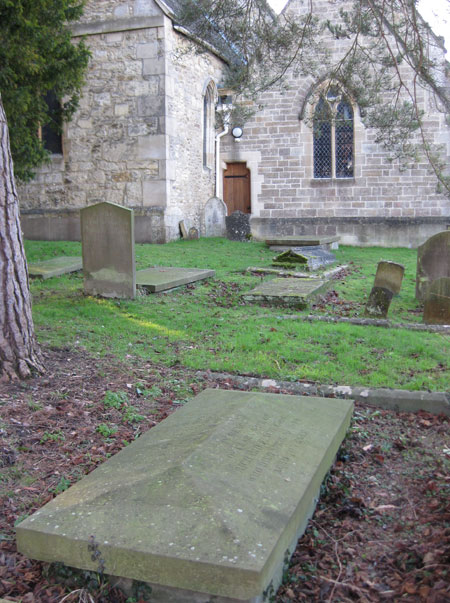
Richard Finch was buried with his wife in the coped grave shown at the forefront of the photograph on the left. The inscriptions on the two surfaces read:
RICHARD FINCH
DIED JULY 24, 1851
AGED 72 YEARS
IN MEMORY
OF CLARA, WIFE OF
RICHARD FINCH, Gent.
WHO DIED APRIL 10, 1849
AGED 70 YEARS
The matching grave beside this one is unmarked: it is probably the grave of Richard’s parents (Richard & Laetitia) and his unmarried sister Laetitia.
Miss Laetitia Finch of Headington (1781–1854), the sister of Richard Finch the Younger
The Rookery continued to be let out after the death of Richard Finch, but his sister Laetitia did not enjoy the rents for long: she died at The Rookery just two and a half years after her brother, on 15 January 1854 at the age of 73, and was buried in St Andrew’s churchyard on 20 January.
Finch Trustees (1854–1863)
The Trustees of the Finch family let the house out furnished between1854 and 1858 to the Revd Dr Arnold, and then made an attempt to sell it in August 1858. This failed, and in October that year they rented it to Revd John William Augustus Taylor, who started a prep school there. He evidently did not want the Finch family’s furniture, as on 23 October 1858 the contents were sold:
“The Rookery”, Headington, near Oxford. All the valuable furniture of the mansion to be sold by Auction by I. & W. Fisher on Tuesday 26 October; comprising capital feather beds, hair and flock mattresses, palliasses, blankets, counterpanes, bedsteads, mahogany and painted chests of drawers, bureaus, wash stands, dressing tables and glasses, presses, wardrobes, and other furniture of the numerous chambers and dressing rooms; telescopic and other dining tables; mahogany sideboard, mahogany hair-seat chairs, sofa (in hair), pier glasses, carpets, druggets, hearth rugs, easy chairs (in morocco and chintz); window hangings and poles, capital cottage pianoforte, sofa (in chintz), mahogany leo, card, sofa, Pembroke, and work tables, bagatelle board, bookcases &c.; also the kitchen furniture, utensils, china, glass, earthenware; likewise a four-wheeled carriage, with patent axles.
The Revd Taylor’s school must have been successful, as in 1863 he bought the Rookery, together with all its land on both sides of the London Road.
See separate page on The Rookery for more information about the house, as well as its subsequent history
